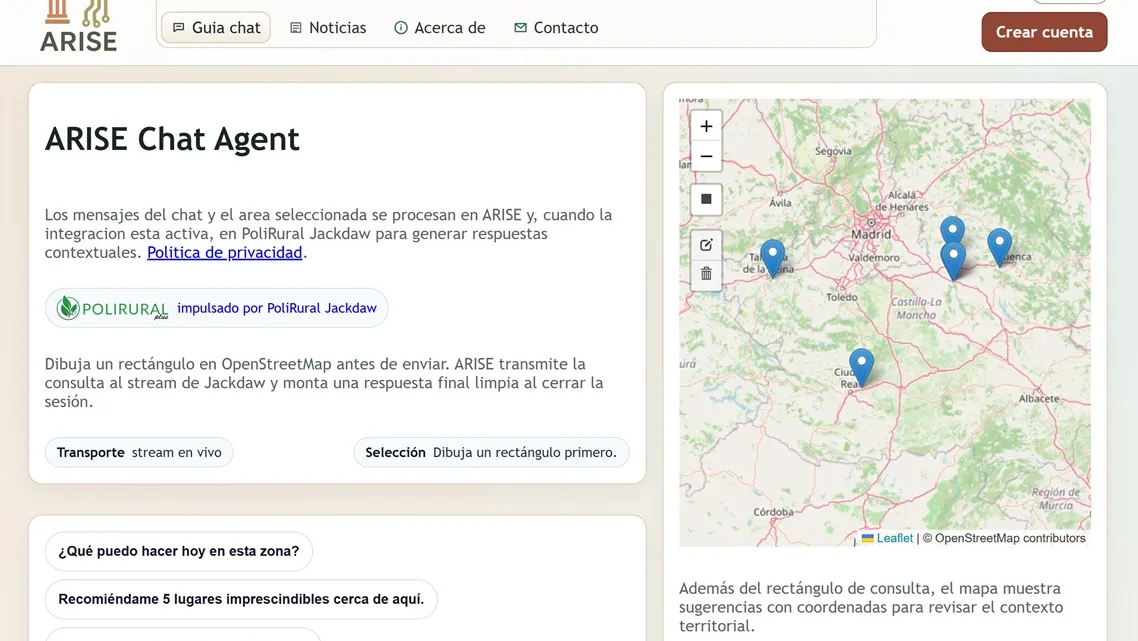
ARISE - Archaeological Routes for Inclusive Synergy & Entrepreneurship in Sierra y Mancha Conquense - is now entering its final implementation phase within PoliRuralPlus. One month before project completion, the platform has already moved beyond concept and is available online as a functioning public prototype at https://arise.xilbi.com/.
The project was created to address a specific territorial challenge in the Sierra y Mancha Conquense pilot region. The area has important Roman archaeological assets, including Segóbriga, Valeria and Ercávica, but these heritage resources have not always been connected through a single digital experience capable of supporting visitors, strengthening local business visibility and improving coordination among territorial actors.
ARISE responds to this gap through a digital platform that links heritage discovery, route planning, local services, territorial information and AI-supported guidance. The public interface already allows users to explore points of interest, discover local businesses, plan routes, access curated news and funding-related information, and interact with the ARISE Chat Agent powered by PoliRural Jackdaw.
This is important for PoliRuralPlus because ARISE is not an isolated tourism demonstrator. It is a territorial digital service that reuses and adapts concepts from the wider PoliRuralPlus ecosystem, including map-based exploration, multi-actor collaboration and data-informed territorial planning. The platform is designed to support both the visitor journey and the operational needs of local and regional actors.
A key part of ARISE is the connection between the public-facing experience and the stakeholder coordination layer. While visitors interact with routes, businesses and guided recommendations, the project also includes a non-public operational environment for content management, integrations, monitoring and MAAT-based stakeholder collaboration. This structure reflects the project’s core objective: to support cultural heritage valorisation, rural business visibility and stronger coordination among local actors.
At this stage, ARISE has already demonstrated several important results. The public prototype is online and accessible. The main user journeys are implemented. The platform includes multilingual elements, map-based discovery, business visibility, route planning, news and funding information, and AI-supported chat guidance. The technical and operational layers have also advanced, providing a basis for maintenance, monitoring and future improvement.
The remaining project period will focus on consolidation. This includes refining the platform, improving usability, strengthening the validated content base, supporting stakeholder activation, collecting evidence for final reporting, and preparing sustainability and replication material. These activities are essential to ensure that ARISE does not remain only a prototype, but becomes a useful reference for heritage-led rural innovation.
The ARISE approach is relevant beyond the pilot area. Many rural territories face similar challenges: valuable heritage and local assets exist, but information is fragmented, visitor journeys are weakly connected, and local businesses are not always integrated into territorial promotion. ARISE offers a practical model for addressing this problem through a shared digital environment that can be adapted to other regions.
As the project approaches completion, the consortium will continue working with the PoliRuralPlus framework to document lessons learned, assess the platform’s contribution and prepare the next steps for sustainability. The aim is to leave behind not only a functioning digital platform for Sierra y Mancha Conquense, but also a transferable model for connecting heritage, local enterprise and rural-urban synergies through digital innovation.
The ARISE platform is available at: https://arise.xilbi.com/
Funding acknowledgement
PoliRuralPlus has received funding from the European Union’s Horizon Europe research and innovation programme under Grant Agreement No. 101136910. Views and opinions expressed are however those of the author(s) only and do not necessarily reflect those of the European Union or the European Research Executive Agency. Neither the European Union nor the granting authority can be held responsible for them.

Existing Comments