
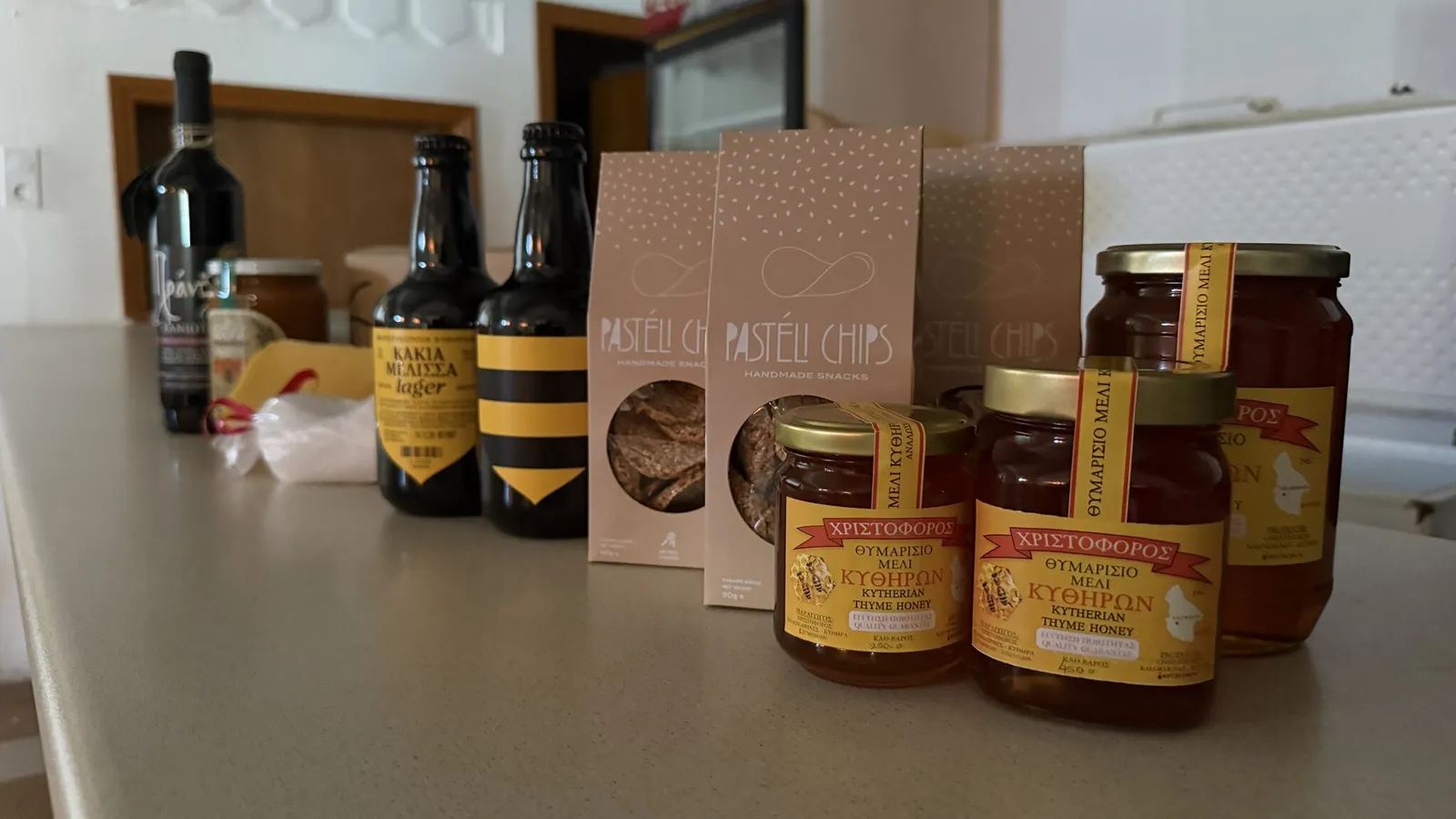
On Saturday, 20 June 2026, a community hall in Chora, Kythera, filled with something you would not usually associate with digital transformation: jars of thyme honey, bottles of local wine and craft beer, packets of pasteli and bags of sea salt. These were not props, but the real products of the island’s farmers and small producers, brought to a hands-on workshop organised under DASK (Digital Agricultural Skills and Knowledge), part of the EU-funded PoliRuralPlus initiative. Delivered together by Daskalos Apps, the Kytherian Foundation for Culture and Development (KIPA) and Environmental Consulting (ENVCON), the session had a deliberately practical aim: to move beyond demonstrations and work with producers on the single skill that most often stands between a good product and an online sale, making that product look as good on a screen as it does on the shelf.
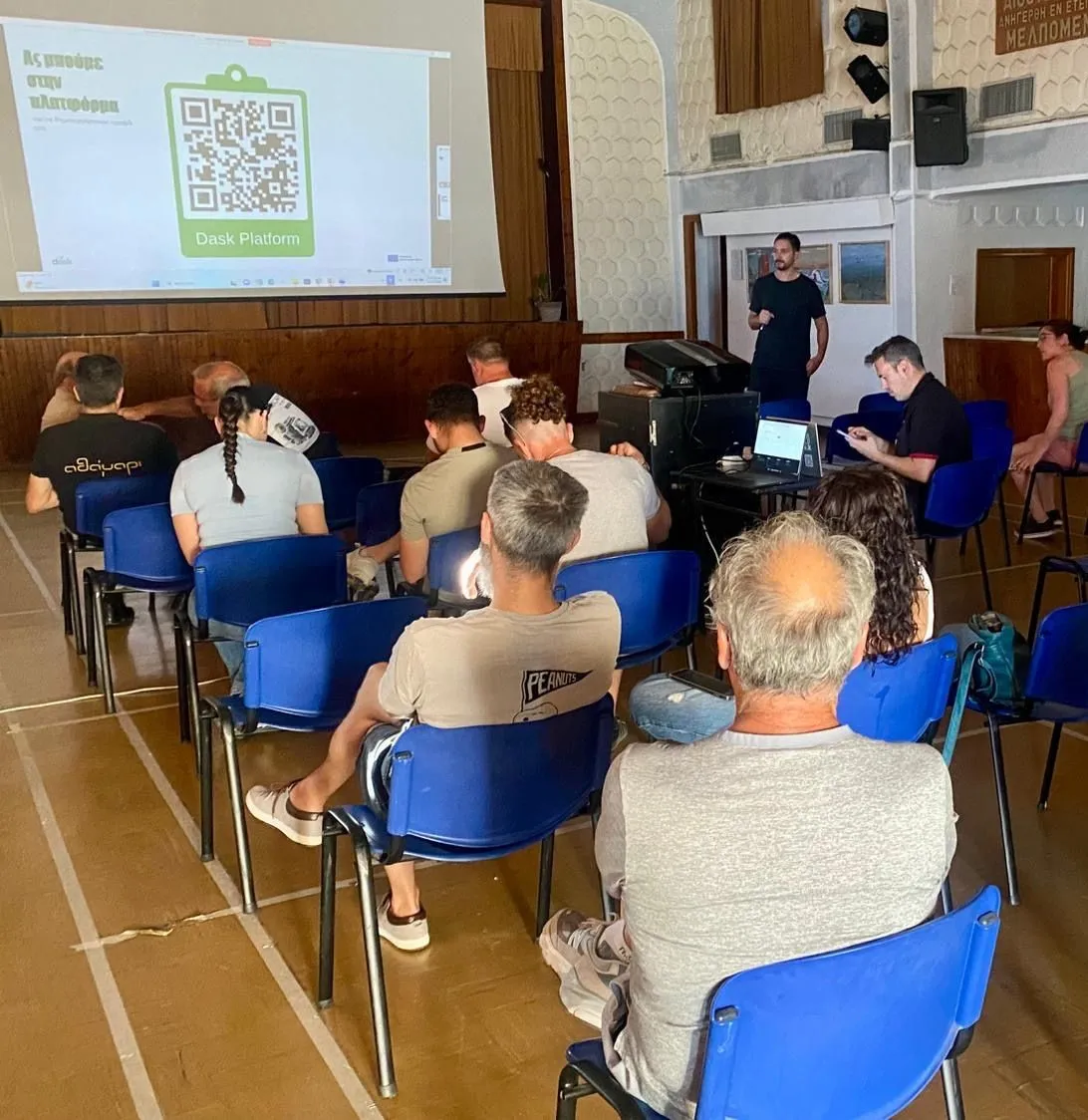
The DASK workshop in Chora, Kythera (20 June 2026): introducing the platform and framing the digital-skills challenge for local producers and agritourism actors.
The barrier is rarely the product
The choice of focus was not accidental. Across Greek agriculture, only around 6.7% of farmers have any training in agricultural technology, against a European average of roughly 25%. On a remote island, that gap is felt as a daily, practical obstacle rather than an abstract figure. DASK’s work with Kytherian producers keeps surfacing the same message: what stops people selling online is seldom a lack of interest or quality, but a shortage of time, confidence and the specific know-how to build a listing. Asked what makes online selling feel heavy, producers point above all to the effort of creating good photographs and descriptions. Reduce that effort, and much of the friction falls away.
Why the image is the product
There is a sound reason photography sits at the centre of this. In a physical market a customer can pick up a jar of honey, hold it to the light and judge its quality in seconds; online, the photograph has to do all of that work at once. It is almost always the first thing a buyer sees, and often the single most decisive factor in whether they look closer, trust the seller and buy. A warm, well-lit image of Kytherian thyme honey signals care, freshness and authenticity before a word is read; a dark, hurried snapshot signals the opposite, however good the honey in the jar may be. In e-commerce the image is not decoration around the product. For the customer, in that first moment, the image is the product.
This matters all the more for the goods Kythera makes. Island producers compete not on price or volume but on quality, provenance and story, and good photography is what lets them convey those things at a distance. Clean, consistent shots build a sense of professionalism, while images that show the place, the landscape, the hands, the farm behind the label, turn an anonymous item into something a buyer connects with and will pay a premium for. This is what DASK calls “digital terroir”: presentation that reflects and amplifies a product’s local character rather than flattening it into a generic listing. A photograph is one of the most direct ways to put that terroir on screen.
From principles to practice in Chora
The workshop turned these principles into practice. Working with the participants’ own goods rather than stock examples, the team covered the fundamentals of product photography, how lighting, a clean background and the right angle can transform an ordinary kitchen-counter line-up into images that look credible in an online store. It then moved to the steps that follow: how to present a product and gradually upload it to the DASK platform, and how products and agritourism experiences can be linked, so a visitor who buys a jar of honey can also discover the farm behind it. Throughout, producers worked with their own labels, packaging and stories.
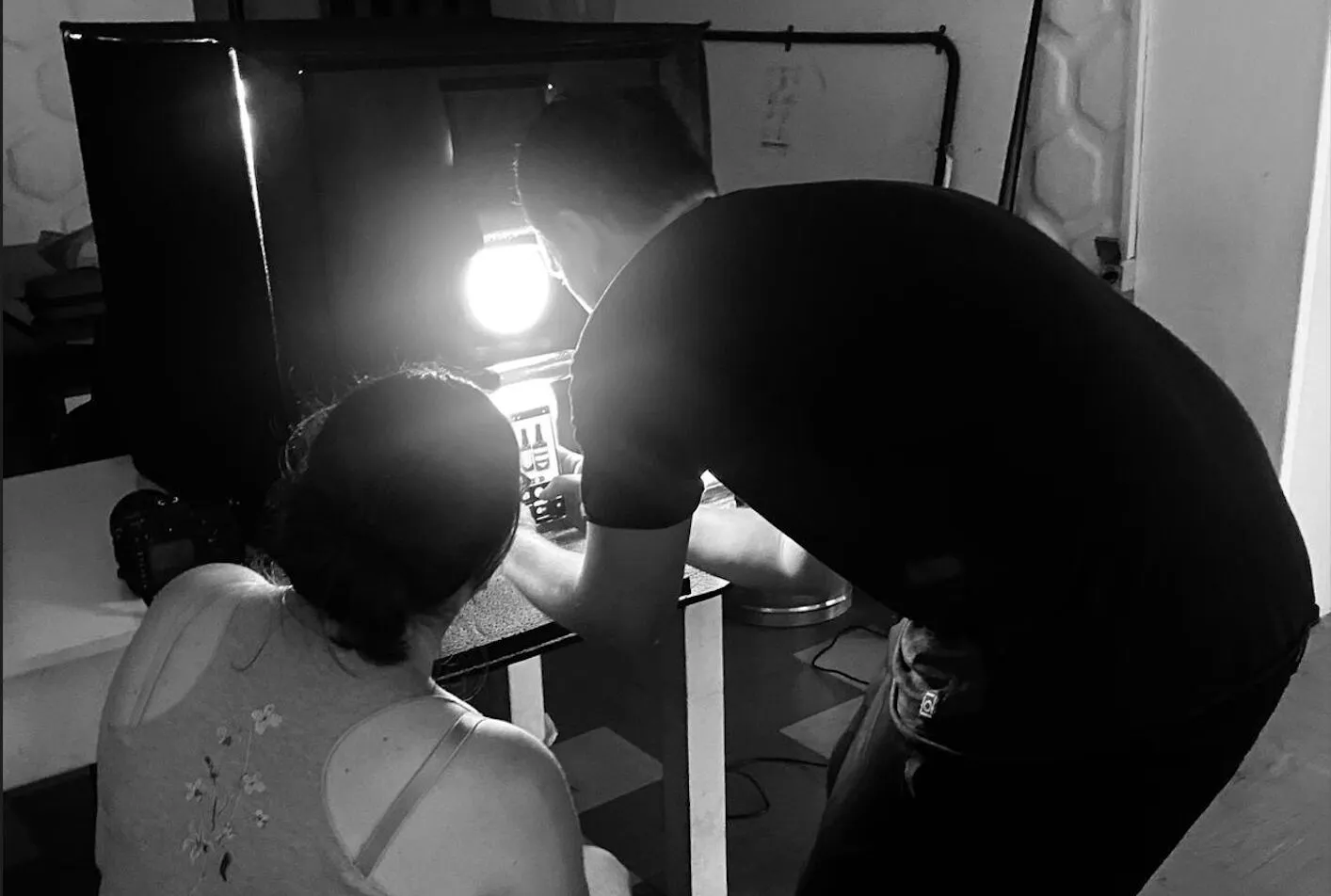
Real island products — thyme honey, wine, craft beer and pasteli — and the hands-on product photography that turns them into credible online listings.
This reflects a lesson DASK has taken seriously from the outset: rural producers do not adopt a marketplace simply because it exists. They adopt tools when the effort of using them is lowered and when they trust both the platform and the people behind it. The clearest request from earlier engagement was for hands-on, one-to-one support rather than generic instructions, and a workshop built around each producer’s own products, in their own community, is exactly that. By teaching the highest-leverage skill first, and in person, DASK lowers the listing burden that keeps good products offline.
From interest to action
The path from interest to action in rural e-commerce runs through capability, and capability often begins with something as concrete as a photograph. When a Kytherian producer can light and frame a jar of honey well, write a short and honest description and upload it with confidence, the island gains a real digital shopfront for the quality it already produces. That is the quiet but decisive shift the Chora workshop set out to support, and, product by product and photograph by photograph, it is how DASK and PoliRuralPlus are turning heritage-rich island agriculture into something the wider market can finally see, trust and buy.
DASK (Digital Agricultural Skills and Knowledge) is implemented under the PoliRuralPlus DEVELOP Call by Daskalos Apps, KIPA and ENVCON.
PoliRuralPlus has received funding from the European Union’s Horizon Europe research and innovation programme under Grant Agreement No. 101136910. Views and opinions expressed are however those of the author(s) only and do not necessarily reflect those of the European Union or the European Research Executive Agency. Neither the European Union nor the granting authority can be held responsible for them.
Existující komentáře