
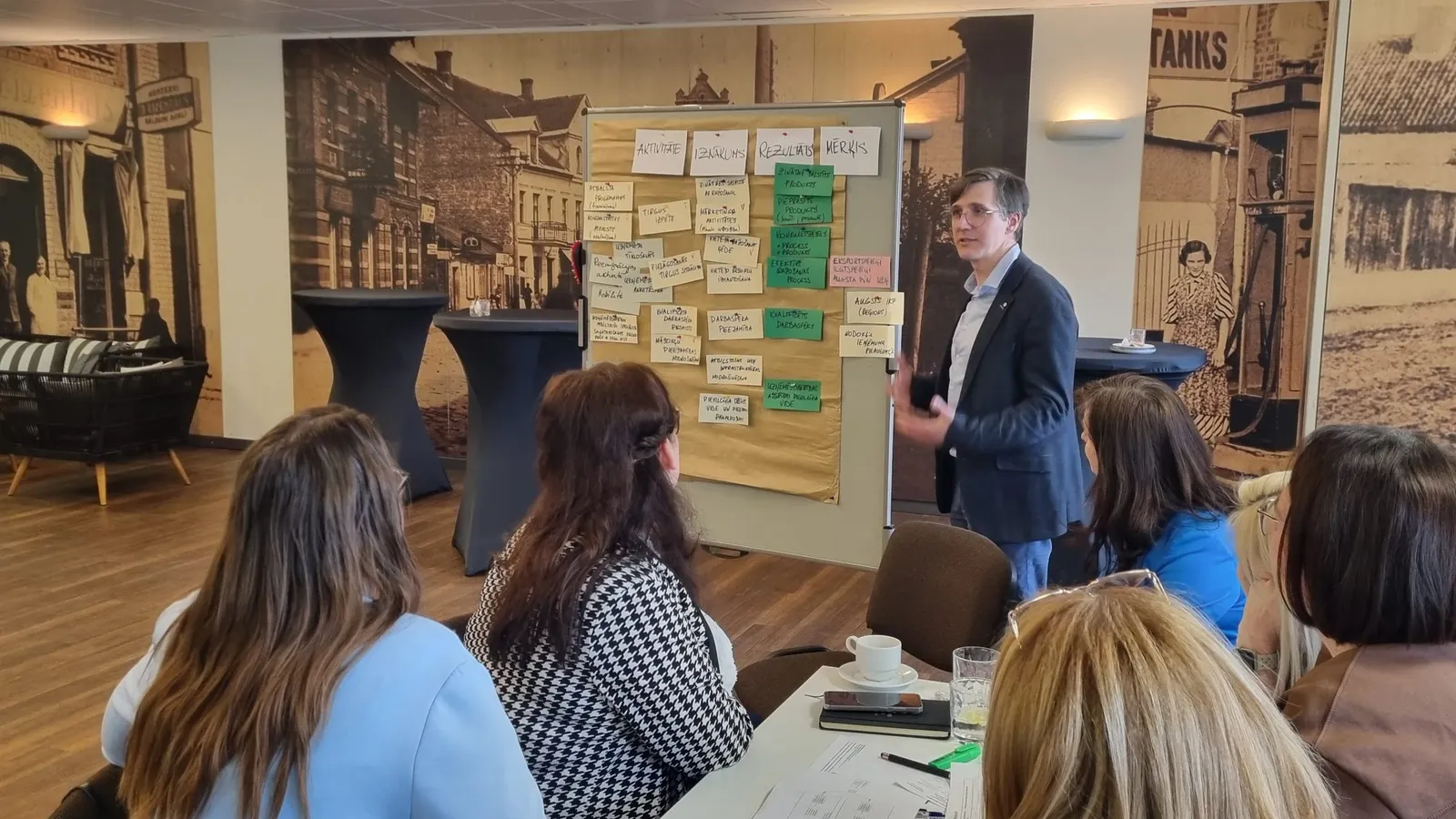
From April to June 2026, specialists from the Vidzeme Planning Region and its municipalities worked together in a series of six workshops to develop a common framework for assessing economic activity and business development across the region. They explored how existing municipal data, together with data from surveys of local businesses, could be used more effectively to evaluate the results and impact of municipal measures and inform future decisions.
The workshop series, Towards a Unified Regional Development Monitoring System: Assessing Economic Activity and Business Development in Vidzeme Municipalities, was organised in cooperation with the European Recovery Fund project Strengthening the Capacity of Local Governments to Improve the Efficiency and Quality of Their Operations. The workshops built on earlier work carried out as part of the PoliRuralPlus project.
Practical challenges affecting the collection and use of data at municipal and regional level had already been identified during discussions with municipal specialists in 2025 and at the Data for Development hackathon. In 2026, workshop participants focused on developing specific solutions for assessing economic activity and the business environment.
During the first stage of the work, municipal development planning and business support specialists analysed the activities implemented by municipalities and how they relate to the results defined in development planning documents. Using a theory of change approach, participants identified the desired changes in the business environment and considered which activities, resources, intermediate outcomes and indicators would be needed to reliably assess progress towards these changes and the resulting impact.
The workshops showed that the indicators included in planning documents do not always clearly link municipal activities to the results achieved. Municipalities also differ in the frequency of data collection, how information is organised and their analytical capacity. A common regional approach therefore requires not only a shared set of indicators, but also agreement on data sources, collection frequency, responsibilities, data management and the use of findings in decision-making.
As a result, a set of six indicators was developed for further discussion. An indicator profile was prepared for each indicator, specifying the data required, the procedures for collecting and updating it, and responsibility for maintaining the information. This would provide a consistent basis for comparing data across municipalities and monitoring regional development over time.
The workshops showed that a common set of indicators alone is not enough to establish a unified approach to regional development monitoring. Municipalities must also agree on how data will be collected, analysed, aggregated, stored and reused. This would provide a consistent evidence base for tracking changes in economic activity and assessing the impact of municipal measures over time.
Each municipality could add questions from relevant thematic modules to reflect its local context and priorities. Using the same core questions would make it possible to compare the results across municipalities and over time.
The proposed framework still needs to be refined and tested in practice through a pilot survey and an assessment of the core questions. The Vidzeme Planning Region has therefore initiated discussions with the Central Statistical Bureau of Latvia regarding the availability of municipality-level data on self-employed persons in the region, as well as possible cooperation in preparing the respondent sample.
The development of a common approach must consider the differences between municipalities in terms of their size, human resources, technical capacity and ability to collect and analyse data regularly. At the conclusion of the workshop series, participants also considered the resources, division of responsibilities, technological solutions and evaluation principles required to introduce and operate a common monitoring system.
The workshops showed that a common set of indicators alone is not enough to establish a unified approach to regional development monitoring. Municipalities must also agree on how data will be collected, analysed, aggregated, stored and reused. This would provide a consistent evidence base for tracking changes in economic activity and assessing the impact of municipal measures over time.


Existing Comments