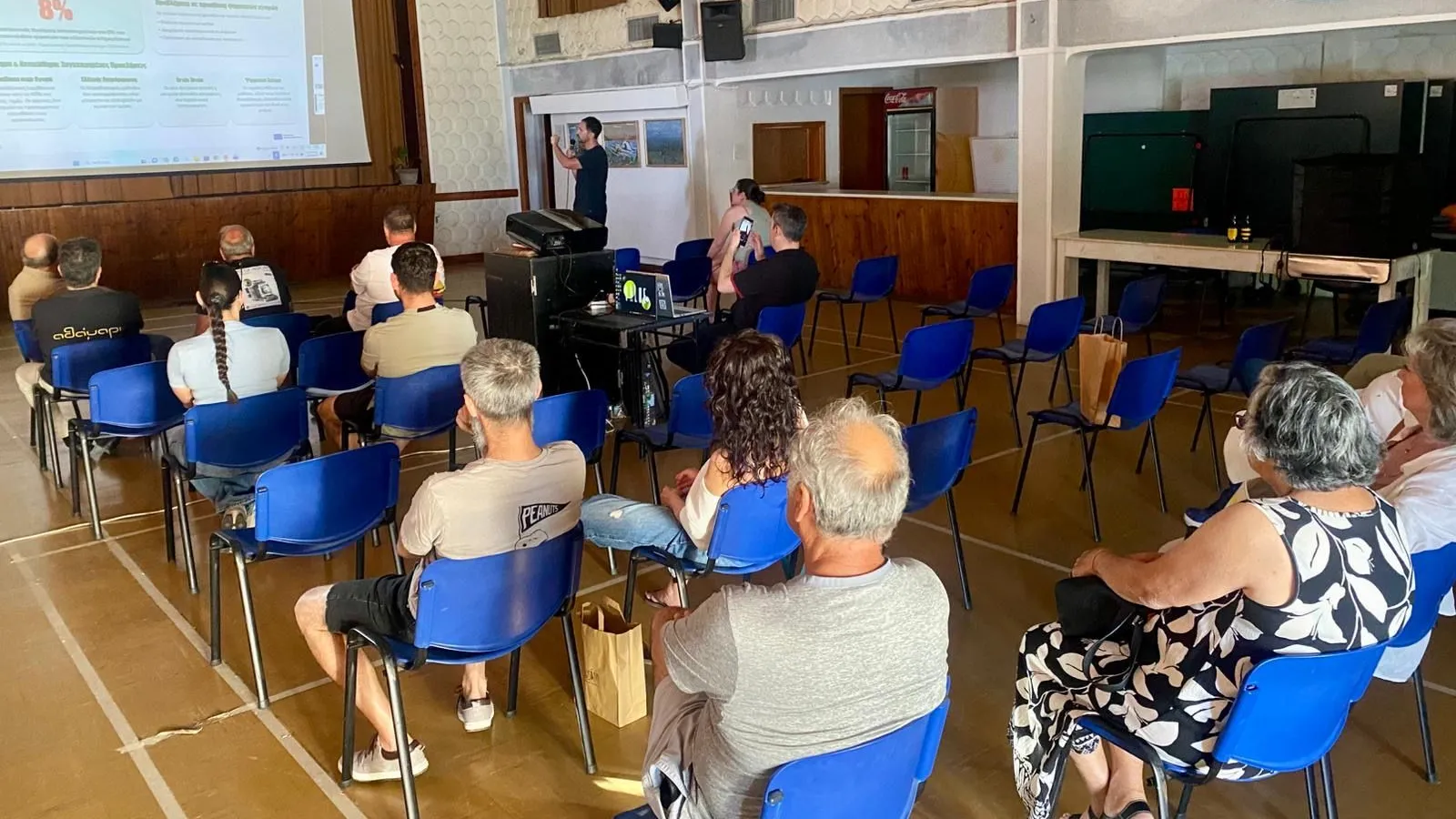
Over the past year, the DASK (Digital Agricultural Skills and Knowledge) pilot has reported on its work in stages: i) the development of an integrated platform for the agricultural communities of Kythera and Antikythera; ii) what local producers told us, bluntly, about what would and would not make them adopt it; iii) how sustainable farming on the island becomes a daily habit rather than a slogan; iv) and, most recently, a hands-on workshop in Chora (Kythera) where producers photographed their own products for sale online. This final piece closes the loop by turning the technical core of that work into something the wider community can scrutinise, reuse and criticise: a scientific publication.
The technical publication, Retrieval-Grounded Multilingual LLM Assistance for Island Smallholder Farmers, is openly available at arxiv.org/abs/2606.25647 , and has been extended and submitted to Open Research Europe, the European Commission’s open-access publishing platform. It describes the assistant embedded in the DASK platform, named Falco eleonorae after the Eleonora’s falcon that breeds on the islands, and known in the Greek interface as “ο Μαυροπετρίτης των Κυθήρων”.
Why a generic chatbot is the wrong tool for an island
The starting point of the paper is a problem the pilot ran into immediately. Kythera and Antikythera combine an ageing and depopulating farming population, a fragmented set of small producers, a strong seasonal agritourism component, and a body of local agronomic knowledge, including a distinctive dialect, that barely exists in digital form. Formal advisory capacity through the Agricultural Knowledge and Innovation System is thin, expensive to deliver in person and hard to sustain in such a territory.
A general-purpose chatbot looks like an obvious remedy. Its knowledge is place-agnostic and enables the users ask it which olive varieties grow on Kythera, or when the local harvest runs, and it will answer fluently and unreliably, with nothing authoritative behind it. The community works in Greek, many prospective users have limited digital experience and intermittent connectivity, and an EU-funded service handling the data of a small, identifiable community cannot treat privacy and data residency as optional extras. Those four constraints, grounding, language, accessibility and trust drove every design decision in the system.
Built thin, on purpose
The first design choice is what the platform deliberately does not do, it hosts no language model of its own. The assistant is a thin Backend-for-Frontend proxy in front of the PoliRuralPlus Jackdaw agent, which runs the answer generation and tool selection upstream. The platform calls a frontier model directly for exactly one bounded task, turning an uploaded field photograph into a short factual description, and uses a managed speech-to-text service, pinned to an EU region, for voice.
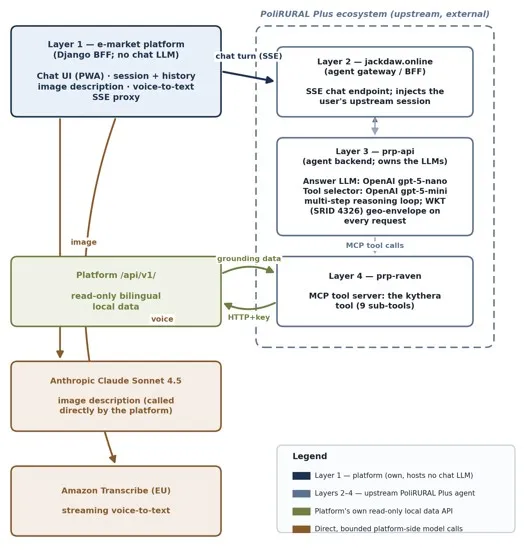
This is not a compromise dressed up as an architecture. A small island pilot has neither the inference budget nor the operational staff to run and maintain a frontier model, and concentrating direct model use in a single well-scoped task keeps the cost surface, the attack surface and the data-egress surface small and auditable. The paper is equally candid about the price of that choice: if the upstream service is unavailable, there is no local fallback.
Grounding without a vector database
The second, and most technically distinctive, choice concerns how the assistant remains impartial. Standard practice would be implementing a vector-store retrieval-augmented generation by embeding a document corpus, retrieve the nearest passages, and generate from them. The DASK platform does none of this. There is no embedding pipeline and no vector database in it.
The reason is the shape of the knowledge. Kythera’s authoritative content is not a large static corpus; it is a comparatively small, structured and frequently edited set of records, crops and their seasons, traditional practices, dialect glossary entries, local products, agritourism experiences, cooperatives and training lessons, maintained by the pilot’s own editors. For knowledge of that shape, exact structured queries beat approximate similarity search. As a result, grounding is done through tool-augmented retrieval instead. A Model Context Protocol tool, contributed by the platform team to the upstream catalogue, exposes the platform’s read-only bilingual data interface to the agent as nine callable sub-tools, from knowledge search and seasonal calendar to glossary lookup and lesson content.
Two consequences matter for the community. First, the editorial controls that already govern the records come for free: drafts, inactive entries and hidden prices are filtered server-side and can never reach the assistant. Second, when an editor corrects a record, the correction is reflected in the very next answer, no re-indexing, no waiting. Local content stays under local control, which is precisely what the research literature on farmer-facing chatbots says is the difference between a tool that is trusted and one that is ignored.
Geography, language and the realities of field use
Every request the platform sends carries a geospatial envelope, a Well-Known Text geometry that anchors the agent to the islands. If the user has not chosen a map area, a default Kythera/Antikythera polygon is supplied, so that even a question with no map in it, for example “which olive varieties grow here?”, is answered for the right place rather than an arbitrary one. Two of the sub-tools, for experiences and cooperatives, use that envelope to restrict and rank results by proximity.
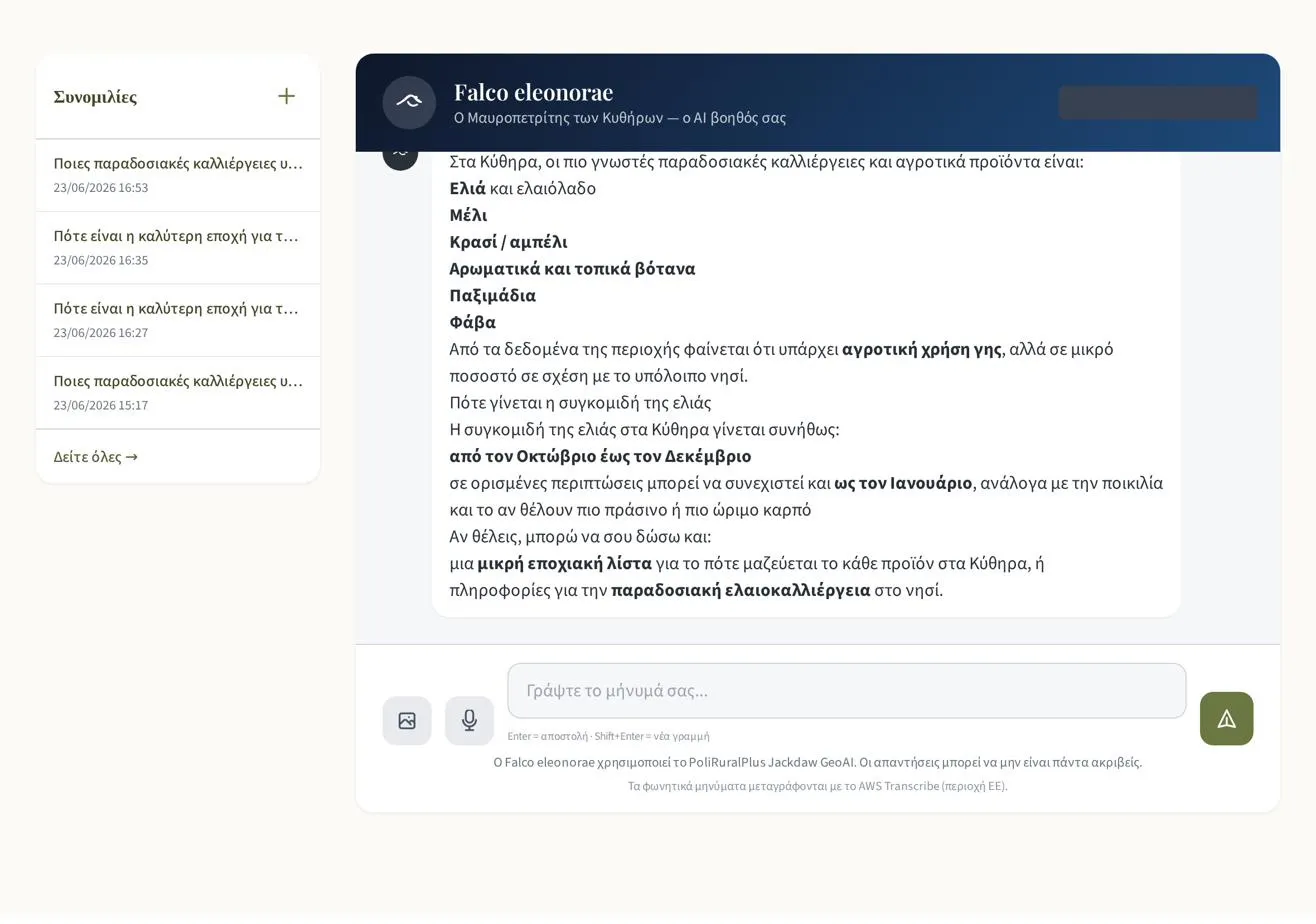
The interface is built for the conditions described in our earlier adoption report. It is Greek-primary with an English toggle that switches the interface, the speech-recognition language and the answer language together. It is delivered as a progressive web application, so it installs to a phone’s home screen and degrades gracefully on weak connections. Answers stream as they are generated rather than arriving all at once, which matters when a tool-using turn takes time. A microphone button lets a user speak instead of typing on an on-screen Greek keyboard, and a photograph of a leaf, a pest or a soil condition can be attached and described. Voice and image support are not novelties here; for users who are uncomfortable with typing, they are the difference between using the assistant and not.
Trust, stated plainly
The paper documents the safeguards in the same detail as the architecture, because in a small community they are part of the product: i) speech transcription pinned to an EU region so audio and transcripts stay in the EU; ii) server-side editorial gating so unpublished drafts and hidden prices cannot surface; iii) rate limiting on the multimodal and data endpoints; iv) sanitisation of model and tool output before rendering; and inclusion of chat content in the platform’s account-deletion erasure routine, so a user who leaves also removes their conversations.
A pattern others can reuse
The reason for writing this up rather than simply shipping it is transferability. The precondition for this design is not scale but curation: a small, structured body of local knowledge under community editorial control, a managed agent service that accepts externally contributed tools, and a thin application layer that enforces language, geography and data-protection policy. Where those three ingredients exist, a managed and grounded multilingual assistant is more attainable, and more trustworthy, than a bespoke self-hosted model, for a Greek island, and equally for a mountain valley or a sparsely populated region elsewhere in Europe. That is the claim the preprint puts on the record for others to test.
Read the preprint: https://arxiv.org/abs/2606.25647.
Explore the platform: https://dask-platform.onrender.com/.
The assistant itself is available in the training section of the platform, https://dask-platform.onrender.com/training/, to users with a PoliRuralPlus account (https://www.poliruralplus.eu/accounts/signup/).
DASK (Digital Agricultural Skills and Knowledge) is implemented under the PoliRuralPlus DEVELOP Call by Daskalos Apps, KIPA and ENVCON, with the scientific work led by the Institute of Communication and Computer Systems (ICCS), National Technical University of Athens. This project has received funding from the European Union’s Horizon Europe research and innovation programme PoliRuralPlus.
PoliRuralPlus has received funding from the European Union’s Horizon Europe research and innovation programme under Grant Agreement No. 101136910. Views and opinions expressed are however those of the author(s) only and do not necessarily reflect those of the European Union or the European Research Executive Agency. Neither the European Union nor the granting authority can be held responsible for them.
Existing Comments