How to write new services for JackDaw
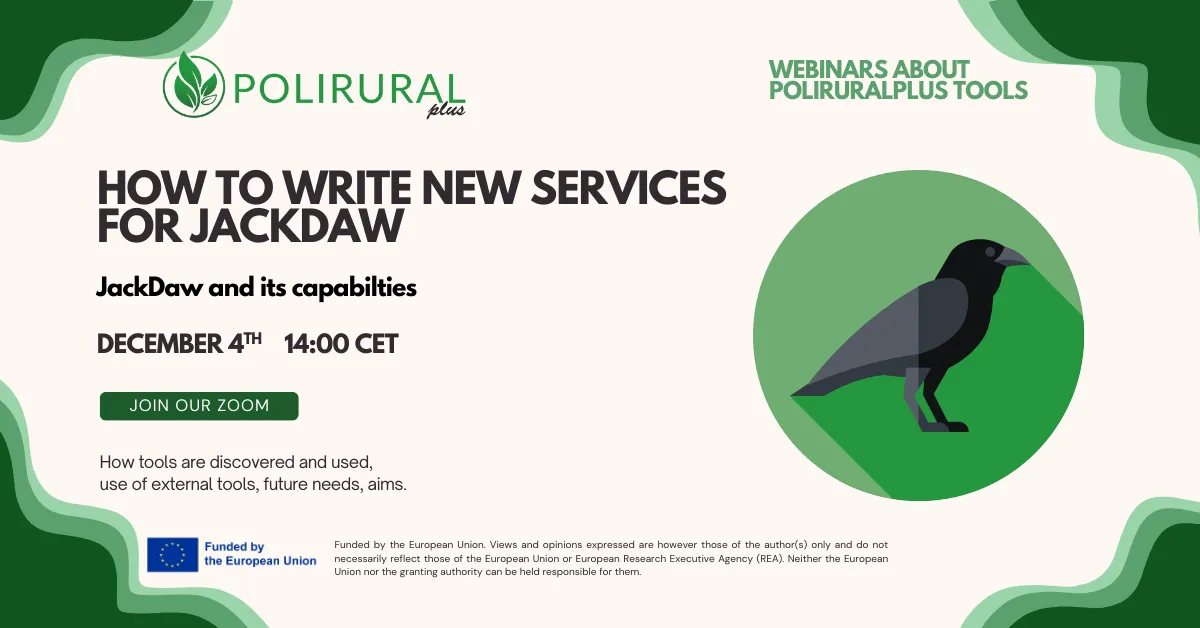
The PoliRuralPlus webinar series continued on 4 December 2025 with a technical deep dive titled How to write new services for JackDaw. The session, led by Filip Leitner (CCSS), offered an in-depth look at the JackDaw system architecture, its integration with large language models (LLMs), and the project’s vision for creating a dynamic and extensible ecosystem of tools and data connectors.
The webinar began with an introduction, followed by an accessible explanation of LLMs, including their core strengths and limitations, such as the lack of real-time data access, limited sector-specific knowledge, and the challenge of context bloat when handling large volumes of information. Filip described how JackDaw extends the functionality of LLMs by incorporating tools that bridge these gaps, enabling richer and more precise interactions with spatial and analytical data.
Participants were introduced to the different types of tools within the JackDaw ecosystem:
- Local tools, which provide essential functionality built into the system;
- MCP (Machine Connect Protocol) integrations, allowing users to securely connect external tools or APIs; and
- Pre-processed data connectors, designed to support “talk to data” scenarios and simplify complex analytical workflows.
A central theme of the presentation was the vision for a dynamic tool catalog and editor, a future development that will allow users to create, register, and manage their own tools and data connectors on demand. This approach aims to improve efficiency by dynamically discovering and loading tools only when needed, rather than storing all options in memory, thereby reducing context bloat and improving system performance.
Filip also outlined the technical challenges associated with these developments including tool discovery, intent extraction, and maintaining semantic and spatial relevance in automated querying. He discussed future directions for JackDaw, such as on-demand API wrapper generation, integration with third-party MCPs, and even enabling the system to generate its own code dynamically.
The session concluded with an open Q&A and an invitation for participants to contribute ideas and feedback. Throughout the presentation, Filip emphasized user empowerment, transparency, and extensibility, positioning JackDaw as a key enabler of data-driven innovation within the PoliRuralPlus ecosystem.
👉 Follow our website and social media channels for updates on upcoming webinars and new developments in the PoliRuralPlus Tools Series, including sessions on retrieval-augmented generation (RAG) and AI-driven data services.