
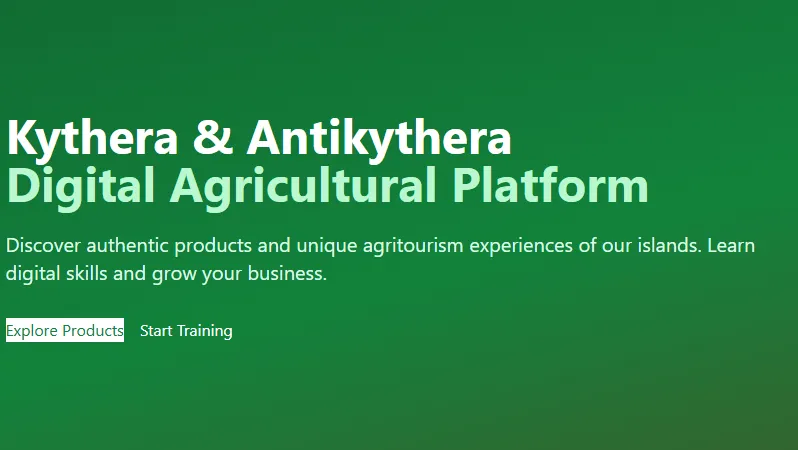
In early February, we hosted a hands-on session in Kythera to introduce local producers and AKIS actors to the DASK platform, our integrated environment for local product promotion, agritourism visibility, and AI-supported guidance. The aim was simple: move beyond demos and gather evidence on what people can realistically adopt, what blocks them, and what would make the platform genuinely useful in everyday rural practice.
Before the session, participants described a digital reality that is neither “offline” nor fully “digital-ready”. Smartphone and basic computer use sit in the middle range for several respondents, and internet access while working is not consistently strong. Past experience with online sales and systematic online promotion appears limited for part of the group, and AI tools are not a given. In other words, this is not an audience that will adopt a complex marketplace platform just because it exists; adoption depends on lowering effort and building trust.
Even so, baseline intent was not dismissive. Several participants were moderately open to trying a unified platform for products and agritourism, and they could clearly articulate what “success” would look like: access to new customers beyond the island, the ability to pre-book experiences, and a tool that remains genuinely simple to use. At the same time, the biggest obstacles were bluntly practical: lack of time, lack of skills, and the effort required to create good listings, particularly photos and descriptions. Concerns about privacy and data safety were present rather than dominant, but clearly not negligible.
After the workshop, the immediate usability signal was encouraging. Most respondents rated the workshop as understandable, with an appropriate pace, and felt the examples were broadly relevant to local reality. That matters, because if people do not see their own context reflected in the examples, adoption collapses early. The “helpfulness” question also hints at something important for rollout: different people anchored on different parts of the platform, with some drawn to product selling, others to agritourism experiences, and others to the AI chatbot and training dimension. This is a cue that DASK is not one product but three value propositions living in one place—and we need to be sharper in how we explain “why” someone should use it.
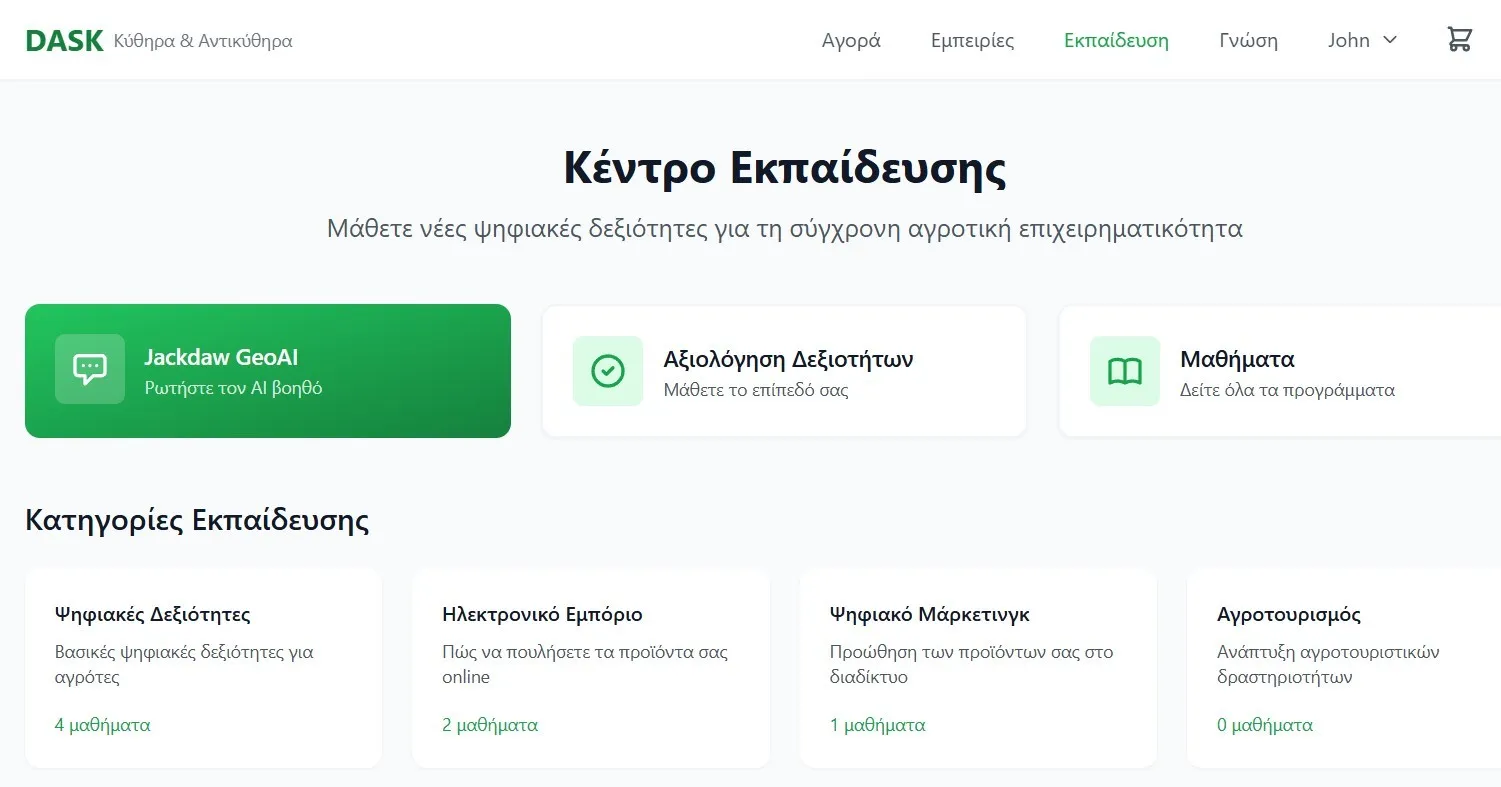
When participants evaluated the platform itself, navigation and language clarity were generally positive but not uniformly “excellent”. The more interesting pattern sits in the perceived realism of doing the work alone. Some respondents felt it is realistic to upload products independently, while others were less confident. This aligns perfectly with the baseline barriers: the friction is not only the interface, but the time and content-production burden. If listing a product means photos, pricing, descriptions, logistics, and the fear of “doing it wrong”, then even a well-designed interface can still be experienced as heavy.
On expected benefits, participants did not automatically assume the platform will generate customers. There is optimism that it can help open new markets, yet a repeated concern is demand: “will there be enough customers?” This is a critical, non-technical adoption constraint. Platforms fail when they ask producers to invest time before there is visible market pull. For Kythera, where producers are rightly sceptical of generic solutions, early traction and credible promotion matter as much as features. A related thread is the request for a “Kythera-oriented” feel and fit, including aesthetics, local relevance, and even certification aspects. That is not cosmetic; it is about legitimacy and trust in a small community where reputation is everything.
Trust and data safety came through as a mixed picture, which is exactly what you would expect at first contact. Some participants expressed confidence that their data will be handled properly, while others flagged privacy and security worries. In the open responses, “security/scams” appears explicitly, alongside worries about who gets access and what kind of users enter the ecosystem. This is another hard truth: without a strong trust narrative and visible safeguards, adoption in rural settings becomes fragile, especially for older participants and for those who already associate online selling with risk.
The AI chatbot received interest, but not blind trust. Participants see value in Greek-language support for promotion and for sustainable practice advice, yet they are far less willing to accept answers “without human checking”. That is a healthy reaction and a design requirement at the same time. If the chatbot is positioned as an all-knowing advisor, it will backfire; if it is positioned as a guided assistant that helps draft text, suggests steps, and points to verified sources or human support, it becomes adoption-friendly. The preferred interaction modes varied - text, voice, and photo-based help all appeared - suggesting that multimodal support is not a luxury but a practical accessibility feature for rural users.
Perhaps the clearest message across the post-workshop answers is what people need in order to actually act. The strongest repeated request is “1-to-1 help”, supported by video guides, step-by-step materials, and backing from cooperatives. This is not a nice-to-have; it is the difference between a demo and real onboarding. People are effectively telling us that the platform must ship with a human support and training layer, otherwise it risks becoming another unused rural tool. In the same spirit, some participants asked for incentives or visibility boosts, while others pointed to the basics, like better internet access, that still constrain digital work in rural areas.
What does this mean for the next iteration of DASK in Kythera? First, we should reduce the “listing burden” by providing templates, default structures, and assisted content creation, so that uploading a product or experience feels like a guided path rather than an empty form. Second, we need a credible go-to-market plan that answers the demand question: how the platform will bring customers, not only how producers will create content. Third, trust has to be designed and communicated: clear privacy choices, visible moderation/verification signals, and a realistic framing of the chatbot as an assistant with guardrails. Finally, Kythera-specific adaptation is not optional; the platform needs to feel locally rooted in both content and presentation, because that is how it earns legitimacy in the community.
This pilot workshop and the before/after questionnaires are a snapshot, not a final verdict. They tell us that the core concept resonates, but they also tell us exactly where adoption will break unless we respond: time, support, trust, and demand. If we build around these constraints rather than ignoring them, DASK can move from “interesting platform” to something that producers actually use in the next months, on their own terms.


Existing Comments