
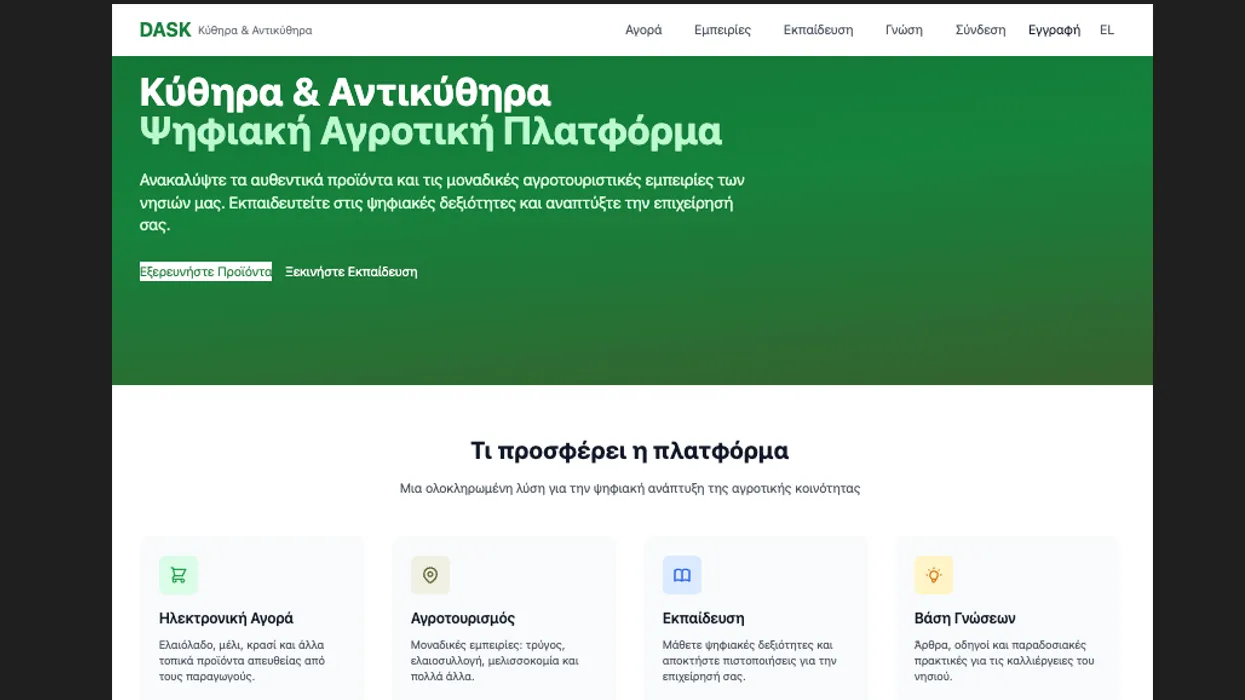
DASK (Digital Agricultural Skills and Knowledge) is moving decisively from concept to implementation with the ongoing development of the DASK Platform, an integrated digital environment designed specifically for the rural agricultural communities of Kythera and Antikythera. The platform is being built to address a very practical barrier identified in the project’s technical description: existing tools for e-commerce, training and advisory services are fragmented, often hard to use, and rarely adapted to the realities of remote island farming and local AKIS actors. DASK’s response is to bring commercial activity, learning, and knowledge support into a single, coherent user experience that is accessible, farmer-friendly, and locally grounded.
The current online instance of the DASK Platform already reflects this “single access point” approach in its structure and navigation. Users can see the core sections that define the project’s integrated model, including marketplace access, experiences (agritourism), training, and a knowledge base, alongside the “Jackdaw GeoAI” assistant presented as a 24/7 virtual helper for questions related to crops, traditional practices, and platform use. It is important to note that what is currently visible on the platform, including product cards, experience listings, prices and sample articles, is indicative demo content intended to showcase workflows and design direction during development and testing. These elements are not yet final “real market inputs”; the final catalogues and content will be progressively validated and populated through stakeholder engagement with local producers and AKIS actors.
At the heart of DASK sit two innovation pillars that are explicitly described in the technical report.
- The first pillar is a unified digital marketplace that combines agricultural products and agritourism in one integrated portal, leveraging the PoliRuralPlus E-market platform and adapting it to Kythera’s needs. The technical logic is straightforward: farmers should not have to manage separate systems for products and farm experiences, and tourists should be able to discover and purchase in a more coherent “place-based” journey. DASK’s integrated marketplace concept supports a single storefront for Kytherian products such as olive oil, honey, wine, rusks, herbs and fava, while also enabling agritourism activities like tastings, tours, cooking classes and seasonal harvesting participation, with integrated booking and storytelling that links products to farms and experiences.
- The second pillar is AI-powered training and digital skills development through the Jackdaw GeoAI Chatbot, positioned not as a generic chatbot but as an intelligent training assistant customised for Kythera’s local context, terminology, crops and knowledge. The technical description is clear that this pillar is meant to bridge both an agricultural knowledge gap and a digital skills gap by providing on-demand support in Greek, personalised guidance for digital marketing and platform use, and sustainable farming advice tailored to local conditions. In practice, this is designed to reduce friction for new users, build confidence for farmers who are not digitally fluent, and preserve local expertise by structuring it into an accessible knowledge base that can be shared across the community.
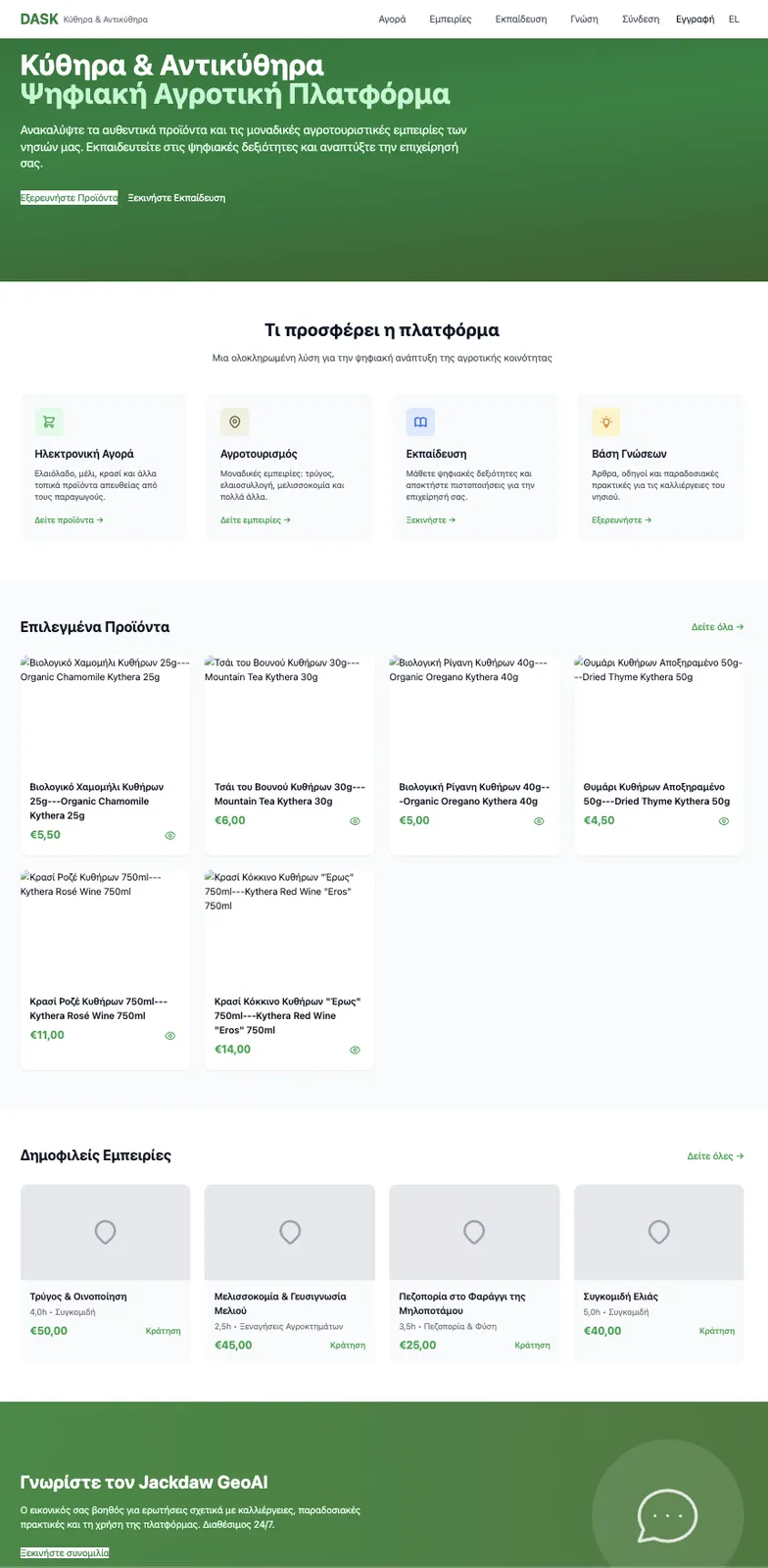
From an engineering perspective, DASK is being developed with a modular architecture intended to scale, integrate cleanly, and remain maintainable. The technical report describes a microservices approach and identifies four main components: an E-market module, an analytics dashboard, an AI training system (enhanced Jackdaw GeoAI), and a knowledge repository. This matters because it moves the project away from a “single website build” mindset and toward a replicable digital system that can evolve over time, integrate new functions, and be adapted to other rural contexts without losing the local character that DASK calls “digital terroir”, meaning technology that reflects and enhances Kythera’s uniqueness rather than imposing a standardised template.
Equally important is the implementation method: DASK is not betting on technology alone. The project plan emphasises participatory design workshops, stakeholder mapping, and a Digital Champions model, recognising that adoption in rural communities depends on trust, usability, and peer-to-peer support as much as on features. The technical description details how respected farmers can act as bridges between technology and tradition, and how co-design activities are used to capture real user requirements and reduce resistance by anchoring the platform in everyday farm realities, including constraints like intermittent connectivity and differing levels of digital readiness.
As the platform matures through iterative development and testing cycles, the priorities remain consistent with the project’s objectives: to strengthen market access, diversify incomes through agritourism, build digital capability, and support sustainable agricultural transformation through integrated tools and locally grounded knowledge. The present platform instance is therefore best read as a functional demonstration of the DASK concept and architecture, with indicative content that will be progressively replaced and enriched through validated inputs from local stakeholders. What matters at this stage is that the integrated structure is in place and aligned with the technical design: a single portal where producers can eventually list and promote real products and experiences, learn practical digital skills, and access a living knowledge base supported by an AI assistant that is designed to work for Kythera, not in spite of it.

Existující komentáře